
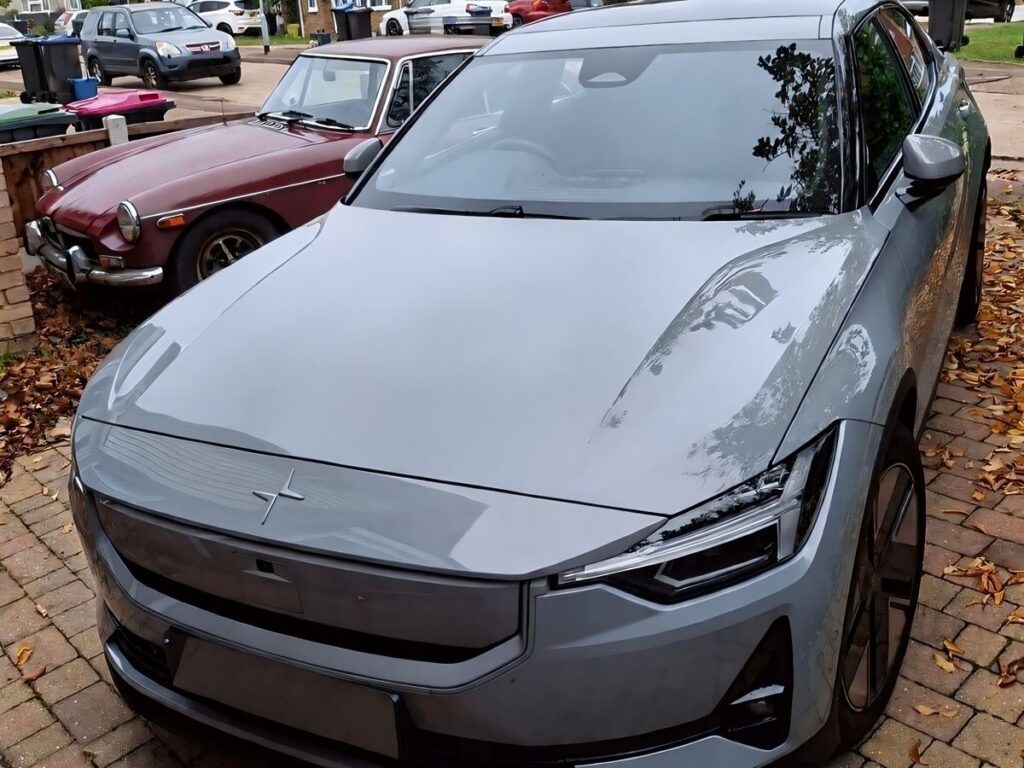
Polestar 2 Long Range Single Motor (2024) Owner Review: A High-Mileage Reality Check
This 2024 Polestar 2 was my very first electric car. Rather than going out and choosing it myself, the car was allocated to me as a used company vehicle simply because it was going spare on the fleet at the time. If there was one silver lining when I took the keys, it was that a Tesla wasn’t the car going spare that day.

Because it was handed over to me second-hand, I wasn’t initially sure which factory option packs had been ticked on the order form. However, the vehicle specification confirms it is the facelifted 220 kW (295 bhp) Long Range Single Motor Rear-Wheel Drive model fitted with the 82 kWh battery (79 kWh usable) and the Plus Pack, finished in grey.
First Impressions and the Positives
To give credit where it is due, the Polestar 2 has an interesting heritage—being closely aligned with Volvo and taking its name from Volvo’s former factory racing team.
As for the car itself, the standout positive for me was the full-length panoramic glass roof included with the Plus Pack, which lets plenty of light into the cabin—though unfortunately, it is a fixed pane of glass and does not open.
Real-World Range and Battery Performance
When you cover between 40,000 and 50,000 miles a year, battery performance and real-world range are everything. Unfortunately, my experience with the Polestar’s battery was very poor.
-
Average Range (80% Charge): Around 200 miles.
-
Rapid Range Drop-off: On day one, a 100% charge displayed a predicted range of 340 miles. Just six weeks and 4,000 miles later, a 100% charge showed 310 miles—and in reality, the car could never actually achieve more than 260 miles on a full charge.
- Winter Drain: Leaving the car parked outside overnight during the winter resulted in the battery losing 10% of its charge before I had even turned a wheel.
My regular commute between home and work is a 303-mile trip. Even setting off with the battery at 100%, the inaccurate and poor real-world range meant the Polestar 2 could never make the journey in one go.
Living With It: Comfort, Tech & Practicality
When asked what my favourite piece of onboard technology was, my honest answer is the Amazon Prime Video app. I ended up watching loads of episodes of TV shows while wasting my life twice a week at gritty motorway service stations mid-trip, waiting for the battery to recharge.
Beyond the range limitations, several day-to-day frustrations quickly piled up:
-
Ride & Comfort: There is a noticeable lack of comfort on long stints behind the wheel.
-
Infotainment Quirks: The system refused to sync properly with multiple phones, and the user manual is only available online rather than in the glovebox.
-
Temperamental Sensors: The rear under-bumper sensor for the hands-free tailgate release worked only when it felt like it.
-
Kerb Weight: Weighing in at well over two tonnes, the car is so heavy that it actually started to sink into my newly paved driveway.
-
Styling: I was never a fan of the grey paintwork.
Reliability and the £320 Puncture
Like many modern EVs, the Polestar 2 comes with no spare tyre. When I suffered a blown tyre, the lack of a spare turned a routine roadside inconvenience into a major logistical headache.
The car had to be recovered to Volvo, where it took them three working days to sort out a replacement. A rental car had to be arranged to keep me mobile while they had it, and the bill for that single replacement tyre came to a staggering £320.
Public Charging & Running Costs: Did It Save Me Money?
In a word: No!
Because I do not have a home wallbox charger and cannot charge at home, I relied entirely on the UK public charging network and workplace chargers. That exposed two major headaches: poor ‘handshake’ reliability when plugging into public and work units, and eye-watering tariffs.
-
Cost Comparison: Running the Polestar 2 cost me £7 to £10 more for every 200 miles driven compared to its internal combustion engine (ICE) predecessor—and that was even when using heavily subsidised IONITY chargers.
-
Public Network Experience: IONITY works out reasonably cheap on a subsidised tariff, though their chargers can be unreliable. Tesla Superchargers can also be cost-effective, provided you are willing to recharge at ridiculously late hours of the night.
-
Hotel Chargers: Destination charging at hotels was the worst culprit—the kWh rates I encountered were the financial equivalent of paying £3.60 per litre for unleaded petrol when compared against a frugal ICE car delivering 65 mpg.
Final Verdict: What’s Next on My Radar?
The Polestar 2 has now gone. For a high-mileage driver covering up to 50,000 miles a year without home charging, electric vehicles simply aren’t fit for purpose for my driving demands.
There are zero EVs on my radar. In fact, I bought a diesel last week to replace the Polestar, and I haven’t looked back.
Review by CNH237E