
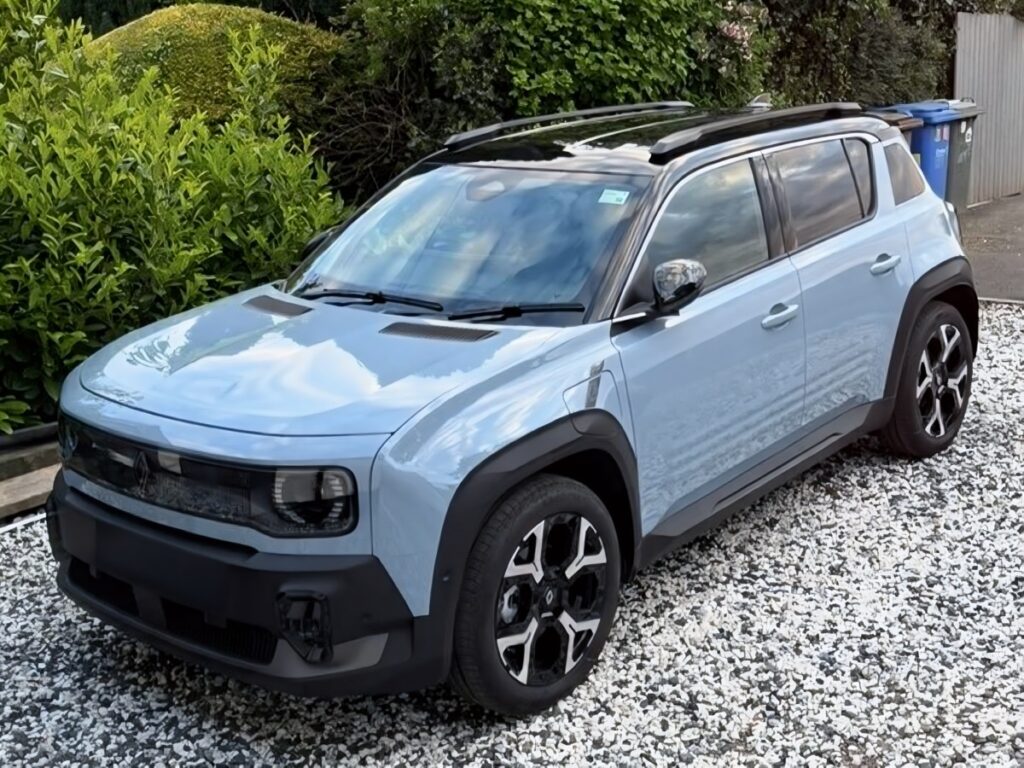
Living with the 2026 Renault 4 E-Tech Comfort Range Techno+: My Honest Owner Review
I wanted an electric vehicle that combined strong everyday practicality, sensible leasing costs, and plenty of character. After researching the market, I chose a 2026 Renault 4 E-Tech finished in two-tone Cumulus Blue with a contrasting Diamond Black roof. Now with between 1,000 and 5,000 miles on the clock, the car has already shifted how I commute day-to-day—taking over regular duties from my fuel-hungry van.

Vehicle Specifications & Why I Chose the Renault 4 Over the Renault 5
Under the bonnet, my car is the Comfort Range Techno+ specification, powered by a 54–55 kWh gross (52 kWh usable) lithium-ion battery paired with a front-mounted 110 kW (150 hp / 148 bhp) electric motor producing 245 Nm (181 lb-ft) of torque. Built on Renault’s dedicated AmpR Small EV platform, it sprints from 0–62 mph in 8.2 seconds with a top speed of 93 mph.
Outside, mine sits on 18-inch diamond-cut alloy wheels with factory roof bars, black wheel-arch cladding, a distinctive illuminated front grille surround, and 18.1 cm of ground clearance. Despite a compact, town-friendly footprint (4,144 mm long and 1,808 mm wide), its stretched 2,624 mm wheelbase unlocks a generous 420-litre boot (expanding to 1,405 litres with the 60:40 split rear seats folded) and an ultra-low 60.7 cm loading sill. Standard kit also includes a heat pump, 11 kW AC bidirectional charging with Vehicle-to-Load (V2L) capability, and 100 kW DC rapid charging (15–80% in around 30 minutes).
When narrowing down my shortlist for my first EV, several factors sealed the deal:
-
Why the R4 Beat the Renault 5: While the Renault 5 E-Tech gets plenty of attention, the superior boot capacity and rear passenger space were the decisive reasons I chose the Renault 4 over the 5.
-
Value & Reviews: An attractive lease cost, a strong standard specification list, competitive range, and glowing ratings from online road tests gave me complete confidence.
-
The Colour: The retro-modern Cumulus Blue finish with the black roof and alloy wheels was the exact look I wanted.
The Positives: Tall-Driver Comfort & One-Pedal Driving
As someone who stands 1.90m (6ft 3in) tall, cabin ergonomics and comfort are an absolute priority—and the driving position in the Renault 4 is spot on for me. Combined with the roomy boot, it handles daily duties effortlessly.
Out on the road, a few mechanical and cabin highlights really stand out:
-
True One-Pedal Driving: The one-pedal function (controlled via steering-wheel regeneration paddles) was a brand-new experience for me, and I love it. The regenerative braking is strong and progressive enough that you genuinely can drive it using just a single pedal.
-
Punchy Performance: With 150 hp on tap in a compact 1,537 kg car, performance is brisk and overtaking slower traffic is effortless.
-
Physical Switchgear: In an era where too many manufacturers bury everything in sub-menus, having proper physical piano-key buttons for heating and climate functions is hugely welcome.
Favourite Tech & ‘Best-Kept Secret’
Inside the cabin, Renault’s dual-screen OpenR Link layout—which pairs a 10.3-inch customisable digital driver’s instrument display with a 10.1-inch central multimedia touchscreen—is intuitive and clear to operate. Having Google Maps built-in gives pinpoint accuracy for navigation, the multi-screen view options in front of the driver work brilliantly, and the Adaptive Cruise Control makes longer journeys a breeze.
As for the car’s ‘best-kept secret’? It has to be the wireless induction phone charging pad in the centre console—it works seamlessly and saves faffing around with charging cables, once you get into the habit of remembering it’s there!
The Negatives: Lane Departure Frustrations & Reno the Avatar
As much as I enjoy the car, there are two electronic quirks that really test my patience:
-
Intrusive Lane Departure Assist: I totally detest the lane departure system and switch it off whenever I’m driving down country lanes or twisty B-roads. Worse still, you cannot turn it off while keeping cruise control active. On narrow rural British roads, the steering intervention feels unnecessary and, at times, genuinely dangerous.
-
Reno the Digital Assistant: Renault’s onboard voice avatar, Reno (or Rene), quickly proved more irritating than helpful, so I have permanently switched him off.
Other than those two software gripes, everything else about the car is spot on.
Real-World Range, Battery Health & Reliability
Although the Comfort Range model carries an official WLTP combined rating of up to 244–247 miles, in everyday real-world driving I consistently achieve an average of 185 miles from an 80% charge (equating to around 230 miles on a 100% charge).
The battery itself still feels as fresh as day one, with zero noticeable degradation. Mechanically the car has been completely reliable, though I have experienced a couple of minor software shutdown glitches—thankfully, both cleared and corrected themselves straight after restarting the car.
Home Charging, Insurance & Van-Beating Running Costs
Because my annual mileage sits between 5,000 and 10,000 miles, I do 100% of my charging at home and haven’t needed to touch the public charging network. Here is how my ownership setup and running costs stack up:
| Ownership Category | My Setup & Experience |
| Home Charging Unit | Evec Home Charger — reliable, straightforward, and completely trouble-free. |
| Electricity Supplier & Tariff | Utility Warehouse — the cheap overnight off-peak window is a little short (1:00 am to 6:00 am), but that 5-hour slot is plenty for a routine overnight top-up. |
| Weekly Charging Cost | Around £3 per week for my regular electric top-ups. |
| Public Charging | Never used; home charging covers all my driving needs. |
| Insurance Provider |
Direct Line — gave me a great quote with a reasonable £350 excess and comprehensive cover, even though this had to be set up as a brand-new policy with my No Claims Bonus tied up on another vehicle. |
Is the Renault 4 E-Tech saving me money? Definitely. Day-to-day, I also run a van whose diesel costs are frankly scary. Before getting the Renault, I was routinely putting £50 a week of fuel into the van. Because I now use the Renault 4 far more frequently for everyday trips, my weekly van fuel bill has dropped to £30, and topping up the EV only costs around £3 a week—putting a clear £17 a week (nearly £900 a year) straight back into my pocket.
(Prices correct as of November 2026)
What’s Next on My EV Radar?
I am very happy with the Renault 4 for the foreseeable future.
Looking ahead to when my lease eventually comes up for renewal, some of the newer Chinese EV models coming into the UK market look tempting on paper—though I plan to wait and see how their long-term reliability, parts supply, and repair networks hold up before making a move.
Review by Mikezhivago