
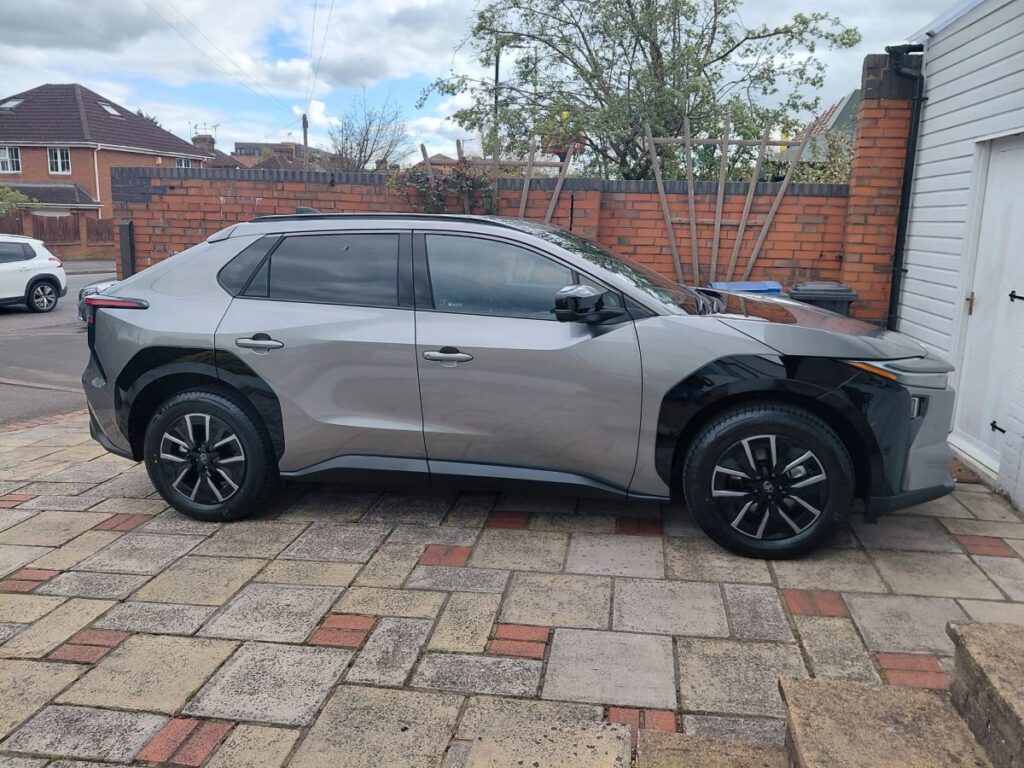
2026 Toyota bZ4X Owner Review: Living With Toyota’s 73.1kWh Electric SUV
Owner: Ian R

In this 2026 Toyota bZ4X Owner Review, I’m sharing my honest, real-world experience of stepping into full electric motoring for the very first time. Having owned my 2026-plate Toyota bZ4X for under a year, I’ve already clocked up between 5,000 and 10,000 miles on UK roads, putting me well on track for my estimated annual mileage of 10,000 to 15,000 miles. If you are weighing up whether Toyota’s flagship electric family SUV delivers on range, comfort, and day-to-day economy, here is how my standard-specification 73.1kWh model has performed so far.
Why I Chose the 2026 Toyota bZ4X
As a first-time EV buyer, peace of mind was right at the top of my checklist. I ultimately chose the Toyota bZ4X because of Toyota’s strong reputation for bulletproof reliability, backed by an industry-leading warranty package. Knowing the car is covered by up to a 10-year (100,000-mile) service-activated vehicle warranty—alongside extended battery protection that can be maintained for up to 15 years (and Toyota’s 10-year/620,000-mile 70% battery capacity guarantee)—took all the anxiety out of switching to electric.
Beyond the warranty, the updated 2026 model offered a very decent real-world range and proved remarkably comfortable and easy to drive from the moment I took it out. I stuck with the standard specification (which on the 73.1kWh Design trim already includes a 14-inch multimedia screen, heated seats, privacy glass, and 18-inch alloys that maximise aerodynamic efficiency) as it had everything I needed without ticking expensive optional extras.
Driving Experience, Favourite Tech & My ‘Best-Kept Secret’
On the road, the bZ4X is effortlessly smooth, quiet, and relaxing. Built on Toyota’s dedicated e-TNGA platform, the 224 hp front-wheel-drive setup gets from 0–62 mph in a brisk 7.4 seconds, yet it never feels intimidating.
In fact, what I consider the best-kept secret about the bZ4X is its sheer simplicity behind the wheel. Rather than overwhelming you with flashy, complicated multi-mode drive selectors, it keeps daily driving refreshingly straightforward with just Eco and Normal modes. You simply get in, press the button, and enjoy a planted, comfortable ride.
When it comes to technology, my standout features are the safety aids and the regenerative braking system. Toyota’s T-Mate safety suite—combining forward-facing cameras, radar, lane trace assist, and pre-collision alerts—works unobtrusively in the background, whilst the deceleration boost (regen) mode makes slowing down in traffic smooth while feeding valuable energy back into the battery.
Real-World Range & Battery Performance
Range is often the biggest talking point for new EV owners, and the 73.1kWh battery in the revised 2026 bZ4X has genuinely impressed me.
-
80% Charge Average: Year-round, I comfortably achieve an average of 300 miles from an 80% charge.
-
Summer Peak Range: As temperatures warmed up over the summer months, the battery performance improved even further, climbing to a phenomenal top range of 392 miles— comfortably beating the official 352-mile WLTP combined figure thanks to gentle everyday driving and effective regen.
-
Reliability: Over my first 5,000 to 10,000 miles, I have experienced zero faults or issues with the vehicle, and the battery feels every bit as strong as day one.
The Positives & Negatives: What Could Be Better?
What I Love Most (The Positives):
-
Superb Range & Economy: Getting 300 miles on an 80% charge and up to 392 miles in the summer makes range anxiety a non-issue.
-
Comfort & Ease of Use: The raised SUV seating position, compliant suspension, and fuss-free driving modes make long stints effortless.
-
Reassuring Tech: The active safety systems and regenerative braking are top-notch.
What Could Be Improved (The Negatives):
-
Infotainment Complexity: While the central touchscreen is well-equipped, Toyota could definitely simplify some of the infotainment menus and layout to make them more intuitive on the move.
-
Even More Range: Although the summer figures are brilliant, you can always wish for manufacturers to push baseline all-weather EV range even further for future models.
Home Charging, Energy Tariff & Public Networks
Because of the bZ4X’s generous battery capacity, I do 100% of my charging at home and haven’t needed to use the public charging network at all.
-
Home Wallbox: I have a dedicated home charging unit installed on the driveway. While it is very easy to plug in and use day-to-day, I would like a bit better app and scheduling control over the unit itself.
-
Energy Supplier & Tariff: My home electricity is supplied by Octopus Energy, and I am currently on a fixed tariff until December 2026, which keeps my domestic charging costs predictable and low.
Insurance, Maintenance & Money-Saving Verdict
Is my Toyota bZ4X saving me money compared to my previous cars? Yes, without question.
Running a pure battery electric vehicle (BEV) is noticeably cheaper than running either a traditional petrol car or a plug-in hybrid (PHEV). One of the biggest hidden costs with a PHEV is that you are effectively paying to service and maintain two separate drivetrains (both an internal combustion engine and an electric motor/battery system), whereas the bZ4X only has a single, low-maintenance electric powertrain.
On the insurance front, I personally insure the car through AA Insurance. My only slight hurdle was right at the beginning: because the car was brand new for 2026 and the registration number hadn’t yet filtered through to all the insurance databases, it was initially quite difficult to get quotes until the vehicle was properly registered on their systems.
What’s Next on My EV Radar?
If I had to hand back my keys tomorrow, another Toyota bZ4X would go straight to the top of my shortlist purely because my ownership experience has been so positive and trouble-free. However, looking across the wider market, I’m also tempted by newcomers like the Omoda 9, the Jaecoo 8, and a couple of models from MG, mainly because of their competitive pricing and value for money.
Additional Information
-
Trim & Drivetrain: Design Edition, 5-Door Crossover SUV, Front-Wheel Drive (Single 165kW / 224 DIN hp Electric Motor, 1-Speed Automatic)
-
Exterior & Wheels: Precious Metal Silver with contrasting black wheel-arch cladding and standard 18-inch 5-double-spoke aero alloy wheels
-
Battery Size: 73.1kWh gross (69kWh usable capacity) with 11kW AC onboard charger and 150kW DC rapid charging capability.