
2017 Tesla Model S 75kWh Owner Review: What It’s Really Like Living With a 9-Year-Old Tesla Without a Home Charger
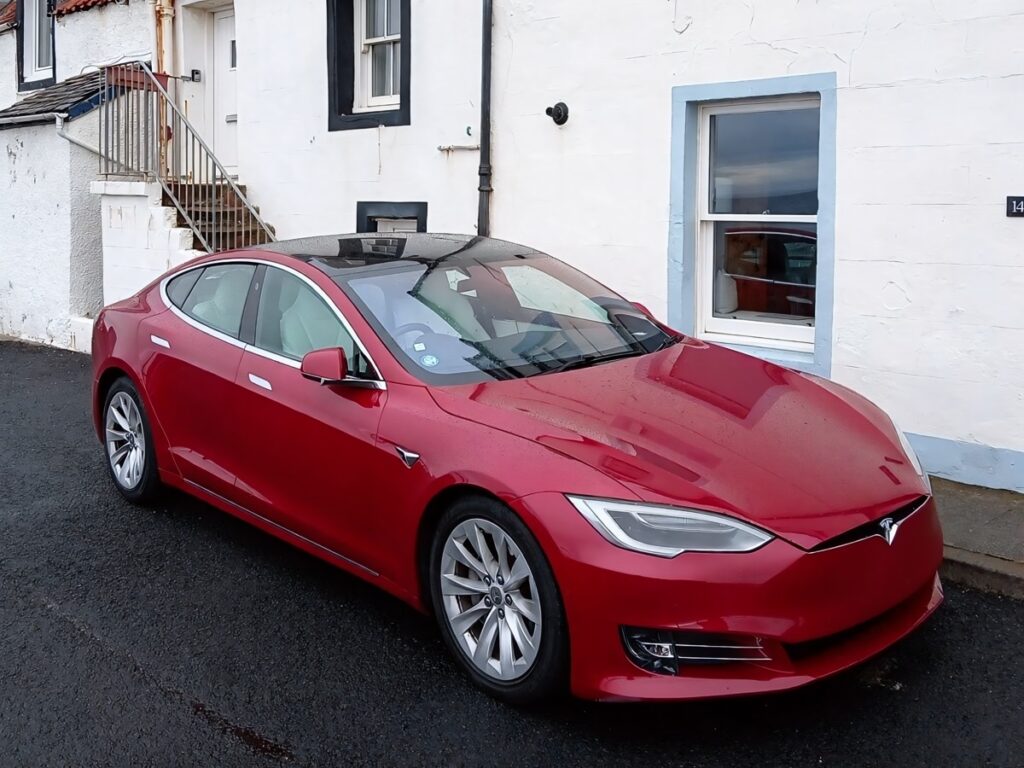
In this 2017 Tesla Model S 75kWh owner review, John McBeath shares what it is really like to buy and run a high-spec used Tesla saloon in the UK without a home wallbox. After 2 to 3 years of ownership—and with the car now sitting at 9 years old and between 60,000 and 70,000 miles—here is John’s honest verdict on battery degradation, Tesla Mobile Service driveway repairs compared to his old diesel Jaguar, and public charging across Scotland, England, and France.

Quick Vehicle & Ownership Summary: At a Glance
-
Owner Reviewer: John McBeath
-
Make & Model: Tesla Model S (75kWh)
-
Year of Registration: 2017 (September)
-
Exterior Finish: Red Multi-Coat (optional multi-layer factory paint)
-
Battery Size: 75kWh (72.5kWh usable when new)
-
Specification & Optional Extras: High-specification model with lots of factory extras, including the all-glass panoramic roof, Premium Sound system, Red Multi-Coat paint, Self-Driving / Radar Cruise Control capability, and the upgraded MCU2 infotainment display
-
Length of Ownership: 2–3 years
-
Current Mileage: 60,000–70,000 miles
-
Estimated Annual Mileage: 5,000–10,000 miles
-
Previous EV Experience: First electric car (previously owned a diesel Jaguar)
-
Average Real-World Range (80% Charge): 150 miles
-
Battery State of Health (SoH): 87% after 9 years
-
Home Charging: None (100% public network charged)
-
Best Public Charging Networks: Tesla Supercharger network, ChargePlace Scotland, and French public networks
-
Insurance Provider: Churchill.
Why I Chose a 2017 Tesla Model S Over an Electric SUV
This 2017 Tesla Model S 75kWh is my very first electric car, which I bought around 2 to 3 years ago after previously running a diesel Jaguar.
When I was looking to make the switch, I was immediately drawn to the styling of both the exterior and the interior, alongside the performance, handling, and the sheer amount of space inside the cabin and boot. Above all, the fact that the Model S is a sleek saloon/liftback and not an SUV was a major benefit in my eyes—especially when it comes to the proportions and styling of the car.
Finding an example packed with desirable options sealed the deal. Mine features the expensive Red Multi-Coat paintwork, the panoramic glass roof, the upgraded premium sound system, self-driving/radar cruise control hardware, and the upgraded MCU2 touchscreen display.
Driving Dynamics, Performance & Onboard MCU2 Tech
If you ask me what the best-kept secret of the Model S is, it is simply just how good it is to drive. I love the way it handles the road: it is effortlessly quick when you put your foot down, yet remarkably docile and easy to drive slowly around town. On longer motorway journeys, the radar cruise control is great and takes the strain out of long stints behind the wheel.
Inside the cabin, having the upgraded MCU2 display makes a huge difference when you are parked up or waiting at a charger. My favourite tech features are the built-in Netflix, YouTube, and Disney+ streaming apps, which turn the 17-inch screen and premium sound system into a proper mobile cinema.
Real-World Range & 9-Year Battery Degradation (60,000–70,000 Miles)
One of the biggest questions people ask about buying a used EV is how the high-voltage battery holds up as it approaches a decade on the road.
-
Battery Health After 9 Years: My 2017 Model S now has between 60,000 and 70,000 miles on the clock, and the 75kWh battery is still sitting at 87% state of health after 9 years—only 13% degradation since 2017, which I think is excellent.
-
Everyday Range (80% Charge): From an 80% charge, I achieve an average real-world range of 150 miles year-round (putting a 100% full charge at around 185–190 miles).
While the range is OK for my 5,000 to 10,000 miles a year, it is the one area where I wouldn’t want any less range than I currently have.
Reliability & Tesla Mobile Service vs My Old Diesel Jaguar
Across my 2 to 3 years of ownership, I haven’t had a single significant fault with the car.
Whenever minor maintenance or repairs have been needed, Tesla Mobile Service comes out and carries out the repairs right at my home, which is wonderfully convenient. In terms of upkeep and servicing bills, the maintenance costs have worked out very similar to my last car, a diesel Jaguar.
The Positives & Negatives: My Honest Verdict
The Positives: What Makes the Tesla Model S Great
-
Superb Driving Bandwidth: It is thrillingly quick when you want it to be, yet smooth and easy to drive slowly.
-
Sleek Non-SUV Styling & Space: Handsome exterior and interior design with massive practicality, without having to buy an SUV.
-
Proven Battery Longevity: Retaining 87% battery capacity at 9 years old and 60,000–70,000 miles inspires real confidence.
-
Long-Distance Ease: Great radar cruise control paired with the seamless Tesla Supercharger infrastructure on long drives.
-
Convenient Driveway Servicing: Tesla’s mobile technicians handle repairs at home for similar money to a diesel Jaguar.
The Negatives: What Could Be Better?
-
Modest Range by Modern Standards: Achieving 150 miles from an 80% charge is OK, though I certainly wouldn’t want any less.
-
Public Charging & Insurance Costs: Insuring a Model S is pricey, and relying purely on public chargers costs about the same as petrol or diesel.
Living Without a Home Charger: Scotland, England & France Compared
Unlike many EV owners, I do not charge my car at home and don’t have a home wallbox installed. Instead, I rely entirely on the public charging network, which has given me a thorough view of what works—and what doesn’t—here and abroad:
-
Tesla Supercharger Network: Hands-down the best system out there and a real plus on long drives.
-
Scotland: The ChargePlace Scotland network has been consistently good in my experience.
-
France: Driving and charging an EV in France is great, with excellent public infrastructure.
-
England: By contrast, I have had lots of issues with non-Tesla public charging networks in England, where reliability and ease of use still lag behind.
Insurance & Running Costs: Is My EV Saving Me Money?
I personally insure the Model S through Churchill, and there is no sugar-coating it—insuring a high-performance Tesla saloon is expensive.
As for whether the car is saving me money on fuel compared to a conventional internal combustion car: not now. Because I don’t charge at home on a cheap overnight domestic tariff and rely exclusively on public charging networks, UK public charging tariffs now work out at a similar cost per mile to conventional petrol or diesel fuel.
What’s Next on My EV Radar?
Even without home charging savings, the way an electric car drives means I am keen to stay in an EV when the time comes to change. If I were to trade in my keys tomorrow, the cars at the top of my list would be a newer Tesla Model 3 or perhaps an MG (such as the MG5 or new IM5 saloon).